


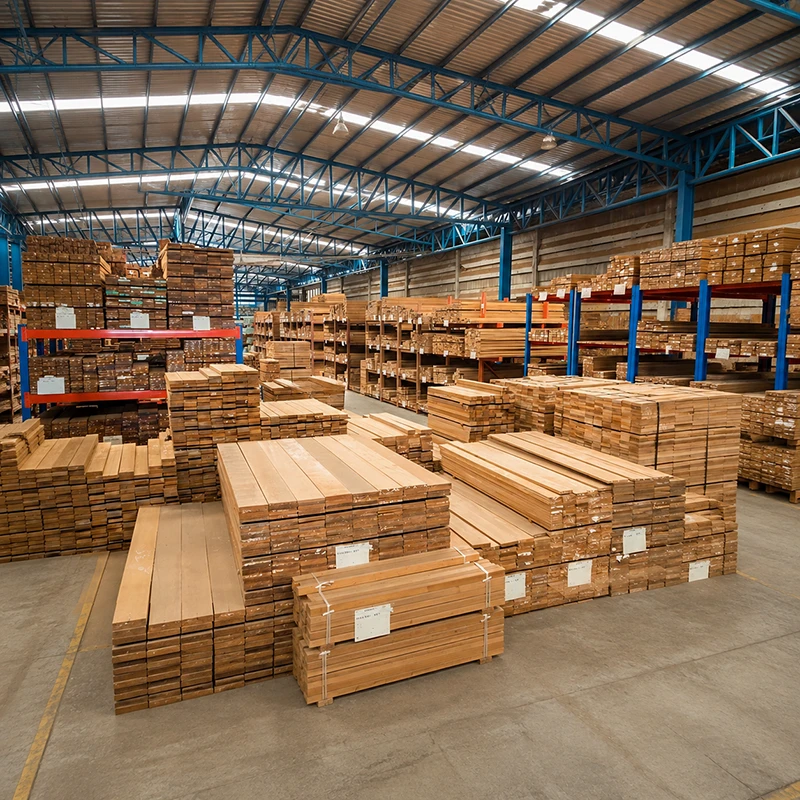
In the realm of solid wood furniture manufacturing, the quality of the final product is inextricably linked to the quality of the raw materials. The foundational step—selecting and inspecting incoming wood—is where the trajectory of a piece of furniture is determined. If issues such as moisture content anomalies, internal stresses, knots, or decay are not intercepted during the Incoming Quality Control (IQC) phase, even the most exquisite joinery and flawless finishing will inevitably lead to post-production defects, such as cracking, warping, and severe color mismatch complaints.
Solid wood is a natural, living material. Relying solely on visual checks is insufficient; a rigorous, scientifically grounded inspection protocol is required.
1. Verification of Wood Identity and Specifications
The first line of defense is ensuring that what you ordered is exactly what has been delivered. Each batch of timber arriving at the factory must be meticulously verified against the purchase order.
- Species Authenticity:For instance, if the purchase order specifies North American White Oak, inspectors must ensure it has not been mixed with Red Oak, Rubberwood, or other visually similar species.
- Basic Specs:Verify the origin, supplier, grade, thickness, length, width, and drying method (e.g., Kiln Dried).
- Approved Wood Sample:For long-term suppliers, maintaining a master physical sample is invaluable for comparing grain patterns, acceptable color variations, and overall material texture.
2. The Core Metric: Moisture Content (MC) Inspection
Moisture content is arguably the single most important parameter in solid wood inspection. Wood that is too wet will shrink and crack; wood that is too dry will swell and warp.
- Multi-Point Sampling:Using a calibrated moisture meter, inspectors must conduct random sampling across every batch. It is a critical error to only test the top board. A robust strategy requires testing boards from the top, middle, and bottom of the pallets, testing both ends and the exact middle of individual boards.
- Core vs. Shell:Particularly for thick lumber, the surface might be dry while the internal moisture remains dangerously high. This discrepancy is a primary cause for future splitting.
- Moisture Variation:It is not enough for the averagemoisture content to meet specifications; the variation within the batch must also be strictly controlled. A batch with boards measuring 8%, 9%, and 15% contains hidden risks. Furthermore, target MC should be dictated by the final destination’s climate, rather than applying a universal standard to all orders.
3. Drying Quality, Internal Stresses, and Warpage
Achieving the correct moisture content does not automatically mean the drying process was successful. Poor kiln operation can destroy otherwise perfect lumber.
- Cracks and Stress:Inspectors must scrutinize the wood for surface checks, end checks, and internal honeycombing. For high-end furniture, a physical internal stress test is recommended. If a cut board immediately pinches or bends, the wood harbors severe residual internal stresses.
- Dimensional Accuracy:Precise measurements for length, width, and critically, thickness are required. Wood thickness must account for the required machining allowance (planing, jointing, sanding).
- Warpage Control:Severely warped wood results in catastrophic material yield loss. Boards must be checked for Bow, Cup, Twist, and Crook (Spring).
4. Natural Characteristics and Defects
Solid wood is a product of nature, and its organic characteristics must be carefully evaluated:
- Knot Evaluation:Not all knots are defects. Live/Sound knotsare solid and structurally sound, often desirable in rustic designs. Conversely, Dead/Loose knots are prone to falling out and are structurally weak. Large or clustered knots on structural components (like chair legs or bed frames) are unacceptable. Lumber must be separated into Appearance Grade and Structural Grade.
- Biological Degradation:Inspectors must look for live insects, boreholes, galleries, and fresh wood powder. Any suspected active infestation demands immediate quarantine. Decay (soft, white, or brown rot) renders wood entirely unsuitable for structural use.
- Mold & Blue Stain:Black spots, white mildew, or blue sapstain usually point to poor moisture control during transit. While blue stain may not reduce structural strength, it permanently ruins the appearance of light-colored woods intended for transparent finishes.
5. Color Matching and Grain Alignment
- Heartwood vs. Sapwood:Species like Walnut exhibit stark contrasts between dark heartwood and light sapwood. An Approved Color Range(Light, Standard, Dark) must be established at the receiving stage to facilitate organized sorting and matching, especially for prominent areas like tabletops and cabinet doors.
- Grain Patterns:Depending on client requirements, wood must be sorted by grain direction (straight grain, cathedral/mountain grain, etc.) during incoming inspection, rather than waiting until the panel-gluing phase.
6. Processing Trials & Logistics
- Machinability:For new suppliers, new species, or unusual batches, a practical processing trial (sawing → planing → milling → drilling → sanding) is highly recommended. This reveals hidden issues like severe tear-out, fuzzing, or unexpected splitting.
- Engineered Wood (Finger-joint/Edge-glued panels):These require additional checks for glue line integrity, joint tightness, and adhesive strength to prevent delamination.
- Transit Inspection:Check packaging for rain damage or forklift mishandling. Often, the top layers appear fine while the bottom layers have absorbed moisture from the ground during transit.
Standardized Workflow and Summary Checklist
A rigorous inspection is only as good as its execution. Factories must establish a formalized “Solid Wood Raw Material Defect and Acceptance Standard” to prevent subjective, experience-based guessing among QC staff.
Recommended Incoming Inspection Workflow:
Supplier/Batch Verification → Species & Dimension Check → Moisture Content Sampling → Warpage/Crack Inspection → Knot/Decay/Insect Evaluation → Color & Grain Grading → (Optional) Practical Machining Trial → Approve for Warehouse / Isolate & Quarantine
Summary: Top 10 Critical Inspection Points for Incoming Solid Wood
No. | Core Inspection Item | Primary Risks & Consequences |
1 | Species Authenticity & Grade | Material mix-ups, incorrect characteristics, financial loss. |
2 | Moisture Content (MC) | Severe cracking, shrinking, swelling, and deformation. |
3 | Moisture Uniformity | Localized stress leading to latent post-production cracking. |
4 | Dimensional Thickness | Inability to achieve net size, significant drop in material yield. |
5 | Warpage & Twisting | Machining difficulties, high scrap rates, assembly misalignment. |
6 | Drying Cracks & Stress | Compromised structural integrity and aesthetic degradation. |
7 | Knot Type and Location | Poor aesthetics, weak structural joints if dead/loose knots are present. |
8 | Insects, Decay, and Mold | Warehouse contamination, structural collapse, aesthetic hazards. |
9 | Color, Sapwood, and Grain | Severe color mismatch, failure to meet client design specifications. |
10 | Machining Performance | Tear-out, splintering, deformation after cutting, and low processing yield. |
Conclusion
Effective incoming material inspection is the bedrock of profitable and high-quality solid wood furniture manufacturing. By transitioning from subjective visual glances to quantified, standardized, and rigorous testing protocols, manufacturers can drastically reduce post-production failures, optimize material yield, and ensure the delivery of flawless, enduring products to their customers.
