


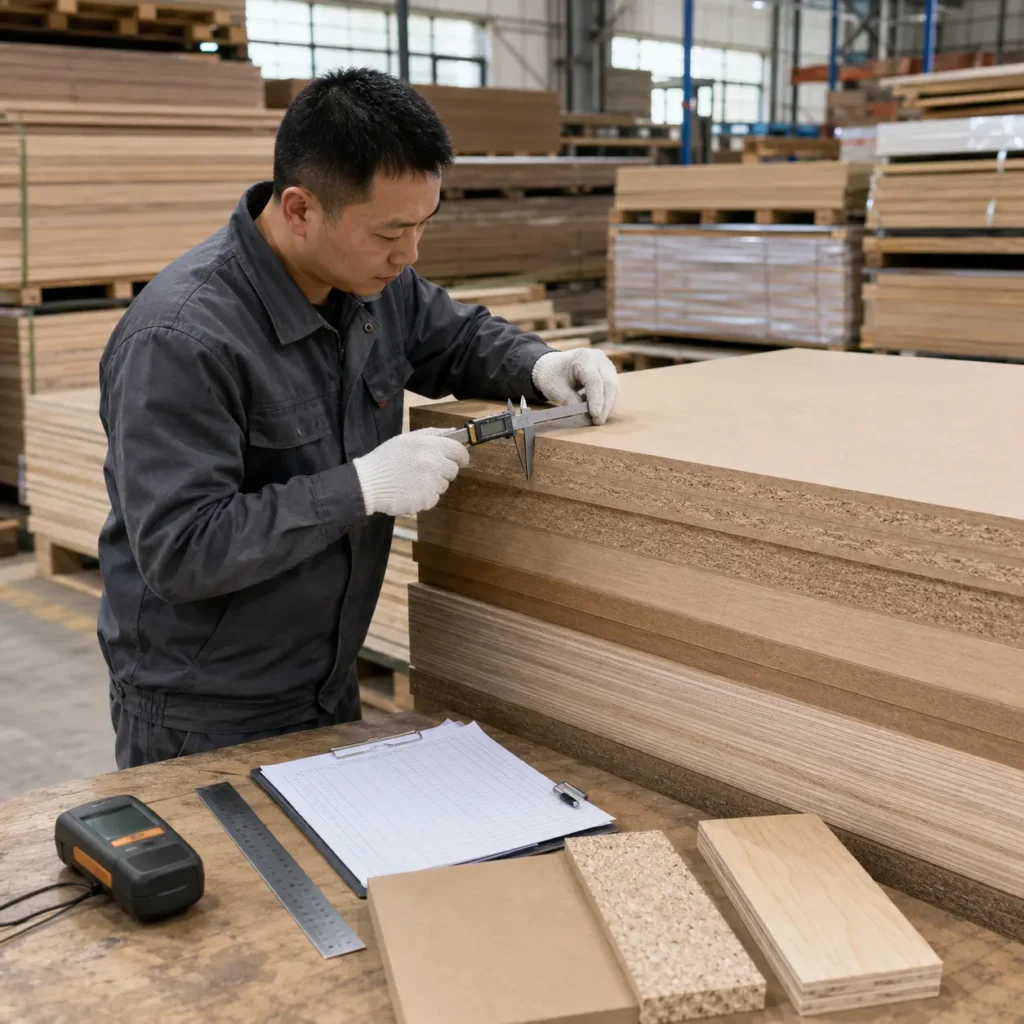
In modern furniture manufacturing, engineered wood panels—such as MDF, particleboard (chipboard), plywood, and OSB—are foundational materials. A common misconception among factory personnel is that these man-made boards are perfectly uniform and only require a cursory visual check upon arrival. In reality, defects occurring during panel manufacturing—such as delamination, weak bonding, or inconsistent core density—often only become apparent after machining, installation, or under environmental stress.
To mitigate quality risks, incoming material inspection must be a structured, multi-dimensional process.
1. Identity Verification and Basic Information Check
The inspection process begins by ensuring the delivered batch exactly matches the purchase order and supplier specifications. Each shipment must be verified for:
- Panel Type & Brand:(e.g., MDF, Particleboard, Plywood, OSB)
- Dimensions:Length x Width x Thickness (e.g., 2440 x 1220 x 18 mm).
- Finish Type, Color, and Environmental Grade.
- Production Date, Batch Number, and Quantity.
Crucial Rule: Never mix panels of the same color from different suppliers or even different batches within the same production run. Variations in underlying base color, wood grain printing, and surface gloss are virtually inevitable and will result in noticeable color mismatches on finished cabinets.
2. Dimensional Accuracy: Thickness, Length, and Squareness
- Thickness Stability:Panel thickness is a highly critical parameter. Using a vernier caliper, inspectors must measure the thickness at multiple points (corners, edges, and center). Unstable thickness directly impacts downstream processes, leading to inaccurate CNC drilling depths, loose cam-lock connections, improper wooden dowel fit, and failed edge banding.
- Length, Width & Squareness:Verify the dimensions against defined tolerances. Panels that arrive shorter than specified cause excessive waste during CNC nesting. Furthermore, squareness must be checked by measuring the two diagonals. A significant difference indicates the panel is out of square, which causes severe alignment issues during electronic saw cutting and automated production.
3. Surface Appearance and Aesthetic Inspection
Inspectors must not only examine the top board but randomly sample panels from the middle of the stack. For all panels, check for scratches, dents, crushing, blistering, delamination, chipped corners, and abnormal discoloration.
For melamine-faced or veneered panels, specifically inspect:
- Clarity and normalcy of the wood grain direction.
- Acceptability of color variation against an Approved Master Sample.
- Consistency of gloss levels within the same batch.
4. Core Structure, Edge Quality, and Density
The internal integrity of the panel dictates its structural performance. Inspectors should examine the cut edges and sample cross-sections.
- Edge Quality:Check if the edges are loose, crumbly, or shedding powder easily. Severe powdering suggests poor resin bonding, resulting in weak screw-holding capacity.
- Particleboard & MDF:Observe if the core particles are uniform and ensure there are no large voids, large impurities, or uneven transitions. For MDF, check for uniform density and ensure the center is not overly soft or porous.
- Weight Monitoring:For regular suppliers, establish a standard weight range. A sudden drop in weight usually signifies reduced density, changes in core structure, or altered raw material recipes.
5. Physical Performance and Machining Adaptability
- Screw-Holding Capacity :This is a highly practical test. Periodic sampling should involve driving screws in, pulling them out, and repeatedly tightening them. A board might look cosmetically perfect, but if screws easily strip the material, it will lead to structural failures.
- Machining Trial :When dealing with new suppliers or batches, a small-scale machining trial (cutting, CNC drilling, routing, edge banding) is strongly advised. Inspectors must look for edge chipping (崩边), excessive powdering, blowout around drill holes, or poor edge-band adhesion.
6. Warpage, Moisture Content, and Delamination
- Warpage :Warpage is a prevalent processing defect. Panels must be laid on a flat reference table to inspect for bow warpage, twist, or edge lifting. Severely warped panels are nearly impossible to rectify if used for large components like cabinet doors.
- Moisture Content:Engineered panels dorequire moisture content checks. Abnormal moisture levels indicate poor warehousing or that panels have absorbed moisture during transit (especially the bottommost panels on a pallet).
- Delamination & Adhesion:For finished panels, random checks for scratch resistance and surface adhesion should be performed. For plywood, verifying the interlaminar bonding strength is vital to ensure layers do not easily separate.
7. Environmental Compliance and Formaldehyde
Formaldehyde emission levels are a critical compliance factor. Upon delivery, QC must verify the declared environmental grade (e.g., E0, CARB P2) and the presence and validity of the testing report. Ensure the report accurately corresponds to the specific supplier and product model being delivered. Additionally, a sudden increase in pungent or abnormal glue smells should trigger an isolation protocol.
Recommended 3-Tier Inspection Frequency Framework
To make factory execution practical, divide inspections into three tiers:
1.Every Batch (Mandatory): Model verification, dimensions, thickness stability, appearance, warpage, color match, packaging, and basic moisture check.
2.Periodic/Sampling (Performance): Machinability trial, screw-holding power, core structure observation, weight/density checks, and bonding strength.
3.Laboratory Verification (Scheduled/New Suppliers): Formaldehyde emissions, physical/mechanical properties, and formal surface wear testing.
Summary: Top 10 Critical Checkpoints for Artificial Boards
No. | Core Inspection Item | Primary Risks & Consequences |
1 | Model & Supplier Verification | Incorrect materials, color mismatch, compliance failure. |
2 | Thickness Stability | Inaccurate CNC depths, loose hardware fittings, dimension errors. |
3 | Surface Defects | Aesthetic rejection, high scrap rates (scratches, blisters). |
4 | Warpage & Flatness | Unusable for doors/large panels, assembly misalignment. |
5 | Color Variation | Noticeable mismatch on finished cabinetry without a master sample check. |
6 | Core Integrity | Weak structural integrity, poor screw-holding (loose particles, voids). |
7 | Machining Performance | Poor edge banding, ragged cuts, high defect rates on the line. |
8 | Screw-Holding Capacity | Stripped screws, weak joints, structural failure of the furniture. |
9 | Environmental Report (Formaldehyde) | Regulatory non-compliance, health hazards, product recalls. |
10 | Moisture/Transit Damage | Panel swelling, edge band failure, unusable bottom boards. |
Implementing a stringent incoming inspection protocol for engineered wood panels is non-negotiable. By moving beyond simple visual checks to evaluate structural, dimensional, and performance metrics, manufacturers can intercept defective materials before they disrupt production, thereby safeguarding product quality and optimizing yield.
