


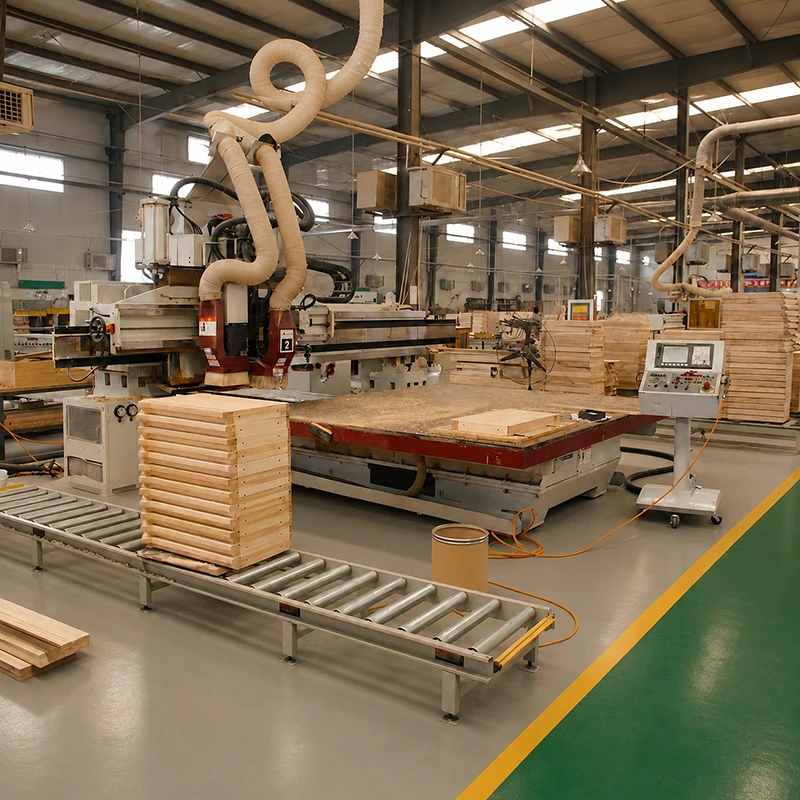
When dealing with export-oriented solid wood furniture, quality control cannot be an afterthought relegated to the end of the production line. Solid wood is a hygroscopic, living material. If defects are not intercepted early, they compound, leading to catastrophic failures—such as cracking, warping, or joint separation—once the product reaches different climates in the US, Europe, Japan, or Korea.
For high-end and export furniture factories, Quality Control (QC) must be a rigorous, end-to-end process spanning from raw material intake to final packaging. Below is the comprehensive, 19-step lifecycle quality control framework required to eliminate post-production defects and ensure international customer satisfaction.
Phase 1: Raw Material and Moisture Management
1. Incoming Raw Material Inspection (IQC)
The foundation of a durable piece of furniture is the wood itself. Incoming Quality Control (IQC) must go beyond a simple count. Inspectors must verify the species, grade, thickness, and procurement batch.
Defect Identification: Scrutinize the lumber for natural and drying defects, including color variations, black spots, insect holes, mold, decay, dead knots, live knots, and cracks.
Dimensional Stability: Check boards for bowing, cupping, or twisting before they enter the warehouse.
Moisture Content (MC): This is the most critical metric. Do not use a universal fixed moisture rate. The target MC must be dictated by the equilibrium moisture content (EMC) of the product’s final destination (e.g., lower for arid regions, higher for humid regions).
Documentation: Establish a strict Moisture Content Record Log that includes the batch number, testing date, and inspector signature.
2. Wood Drying Control
A vast majority of after-sales complaints (cracking, warping, loose joinery) stem from improper wood drying.
Kiln Sorting: Wood must be categorized by species and thickness before entering the drying kiln.
Process Control: Strictly manage the heating rate, kiln temperature, and humidity.
Conditioning: After kiln drying, the wood requires an adequate resting period (conditioning) to balance internal stresses.
Core Testing: For thick lumber and critical structural components, surface moisture checks are insufficient. Assess the internal moisture content to ensure the core is not significantly wetter than the shell—a hidden defect that guarantees future cracking.
Phase 2: Machining and Structural Integrity
3. Machining and Dimensional Tolerances
Once the wood enters the machining phase, precise dimensional tolerances must be established and enforced to ensure seamless assembly.
Critical Measurements: Inspectors must utilize calipers, feeler gauges, and angle squares to verify length, width, thickness, and diagonal measurements.
Joinery Dimensions: Tenon and mortise sizes, CNC routing depths, and left/right symmetrical parts must be strictly measured against the engineering drawings.
Standardization: Create a standard operating procedure (SOP) that dictates the drawing dimension, allowable tolerance, required inspection tool, and sampling rate for every component.
4. Joinery and Structural Quality Control
The longevity of solid wood furniture relies heavily on its structural engineering. Load-bearing items like dining chairs, beds, and sofa frames require dedicated structural standards.
Fit and Finish: Mortise and tenon joints must be perfectly calibrated—neither too loose (which weakens the joint) nor too tight (which splits the wood). Check the insertion depth and ensure there are no visible gaps.
Hardware Alignment: Verify that screw lengths are appropriate, screws are not stripped, and hardware positioning is exact.
Stability: Assembled frames must be tested for squareness and immediately checked for any wobble or instability on a perfectly flat reference surface.
5. Gluing Process Control
When joints fail, it is rarely the fault of the glue itself, but rather a failure in process control.
Application Standards: Monitor the glue type, mixing ratio, application amount, and uniformity of coverage.
Time and Environment: Strictly adhere to the adhesive’s specified open time, pressing pressure, and pressing duration, while factoring in factory ambient temperature and humidity.
Traceability: Retain detailed logs of the glue supplier, model, batch number, and usage date for backward traceability in the event of a failure.
Phase 3: Preparation and Finishing
6. White Body (White Wood) Inspection
Before any furniture enters the finishing room, a dedicated “White Body Inspection” is mandatory. Once a piece is stained or lacquered, repairing structural or surface defects becomes exponentially more expensive.
Overall Assessment: Check overall dimensions, structural stability, and ensure all four legs sit perfectly level.
Functionality: Verify that cabinet doors sit flush, drawers glide smoothly, and uniform gap reveals are maintained.
Surface Preparation: Inspect for excessive wood color variation, obvious repair marks, micro-cracks, edge chipping, glue residue, nail holes, and the overall tightness of joinery.
7. Sanding Quality Control
The final visual and tactile quality of solid wood furniture is dictated by the sanding process.
Grit Sequence: Enforce a strict sandpaper grit sequence (e.g., coarse → medium → fine → final prep).
Surface Checks: Inspect for cross-grain sanding scratches, which will become glaringly obvious once stain is applied (especially on light woods like White Oak). Ensure surfaces are perfectly flat, corner radii are consistent, all wood fibers/splinters are removed, and joints are perfectly flush.
8. Coating and Finishing Control
The finishing process requires a delicate balance of aesthetic appeal and environmental compliance.
Process Tracking: Document the paint model, batch, mixing ratios, spraying viscosity, number of coats, drying time between coats, and film thickness.
Master Color Sample: Every product must be checked against an Approved Master Color Sample in standard lighting to prevent batch-to-batch color drifting (e.g., Batch 1 looking too yellow, Batch 2 too red).
9. Color Variation Management
Because wood is a natural material, absolute color uniformity is impossible, but variation must be managed.
Grading System: Categorize color variations into three tiers: Acceptable, Conditional, and Reject.
Manual Matching: Implement manual color sorting during panel gluing and assembly for highly visible areas (tabletops, door panels) to ensure a cohesive look and prevent stark contrasts on a single face.
Phase 4: Final Product Evaluation
10. Finished Product Functional Inspection
Furniture must not only look good; it must perform flawlessly in daily use.
Cabinetry: Continuously open and close doors and drawers. Check for smooth glide operation, even door gaps, silent hinge movement, proper self-closing functions, and the successful installation of anti-tip hardware.
Seating and Tables: Verify there is absolutely no wobble, check that tabletops and chair seats are perfectly level, and ensure all backrests and structural supports are rigid.
11. Finished Dimensional Checks
Especially critical for e-commerce brands, the physical product must exactly match the dimensions listed online to prevent immediate customer returns.
Check the overall width, depth, and height.
Verify specific ergonomic dimensions like seat height, drawer interior volume, cabinet clearances, and ground clearance against the final engineering specifications.
12. Aesthetic Inspection
Final Quality Control (FQC) must be conducted under standard inspection lighting.
Visual Defects: Scrutinize the piece for scratches, dents, paint sags, orange peel texture, dust particles, bubbles, severe color mismatch, exposed bare wood, and glue marks.
Hardware and Cleanliness: Ensure no hardware is scratched, and wipe away any fingerprints or smudges. High-end products should be inspected based on predetermined “normal viewing distances.”
Phase 5: Testing, Packaging, and Traceability
13. Stability and Load-Bearing Testing
Factories must implement internal Standard Operating Procedures (SOPs) for physical testing, rather than waiting for third-party client audits.
Chairs: Static load on the seat and backrest, sway tests, and impact tests.
Tables: Static load limits, horizontal thrust tests, and leg stability.
Cabinets: Shelf load capacity, drawer load capacity, door hinge durability, and mandatory anti-tip testing.
14. Hardware Inspection
Cheap or failing hardware is a primary driver of after-sales complaints.
Inspect hinges, glides, screws, cam-locks, handles, and levelers.
Verify dimensions, finish quality, salt-spray resistance (rust prevention), lifecycle durability, and load-bearing capacity.
15. Trial Assembly for KD (Knock-Down) Furniture
For export furniture that requires customer assembly, a random Trial Assembly is non-negotiable.
QC must unpack a sample and build it exactly as the end-user would, using only the provided instructions and tools.
Check for accurate hole positioning, missing or mismatched hardware, logical installation steps, and the final stability of the assembled piece.
16. Packaging and Transit Simulation
For channels like Amazon, Wayfair, or Coupang, packaging quality is as critical as the furniture itself.
Material Strength: Evaluate carton burst strength, and the proper use of EPE, EPS, honeycomb board, corner protectors, and pearl cotton. Ensure hardware packs are immobilized and parts are isolated to prevent rubbing.
Simulation Testing: Conduct regular Drop Tests, Vibration Tests, Compression/Stacking Tests, and Incline Impact Tests to guarantee the product survives global logistics.
17. Final Outbound Inspection (FQC)
Before shipping, sample a final percentage of the packed order.
Pre-Packaging: Final verification of appearance, dimensions, and function.
Post-Packaging: Verify shipping marks (Carton Marks), barcodes, product models, quantities, included accessories, manuals, net weight, and gross weight.
18. Quality Traceability System
A mature factory operates on strict traceability. If a warranty claim arises, the factory must be able to trace the exact history of that single unit.
Link the Customer PO → Product → Production Date → Wood Batch → Paint Batch → Hardware Batch → Specific QC Personnel. This allows management to isolate root causes rather than just fixing a single broken item.
19. Defect Classification and CAPA
Shift from a “rework and forget” mentality to a systemic improvement model.
Classification: Group defects into Critical (safety hazards, structural breaks), Major (functional failure, large aesthetic flaws), and Minor (slight visual flaws in non-prominent areas).
Continuous Improvement: Issue an NCR (Non-Conformance Report) for failures and enforce a CAPA (Corrective and Preventive Action) protocol to permanently eliminate the root cause of the defect from future production runs.
Summary Checklist: Core Solid Wood QC Milestones
Production Phase | Key Control Point | Primary Risk if Ignored |
Incoming (IQC) | Moisture Content & Uniformity | Severe warping, splitting, and joinery failure post-export. |
Machining | Dimensional Tolerances | Parts do not fit; forced assembly leading to structural weakness. |
Assembly | Trial Assembly (KD Furniture) | Customer cannot assemble the product; immediate negative reviews. |
Preparation | White Body Inspection | Expensive rework; permanent visual flaws trapped under the finish. |
Finishing | Master Color Matching | Severe batch-to-batch color drift leading to inventory mismatch. |
Testing | Stability & Drop Tests | Safety hazards (tipping cabinets) and catastrophic transit damage. |
Management | Traceability & CAPA | Inability to find root causes, leading to repeated manufacturing errors. |
Implementing these 19 rigorous checkpoints will transform a factory’s quality output, drastically reducing after-sales costs and building long-term trust with international buyers.
