

The Material Decision Drives Everything Else
Most sourcing problems that show up six months after delivery — sagging shelves, swollen edges, a table that moves in a dry apartment, a wardrobe that sways when the door opens — trace back to a material choice made on a spreadsheet, not on a shop floor.
Solid wood, plywood, MDF and particleboard are the four materials behind almost every piece of furniture you can buy. They are not better or worse than each other in the abstract. They are better or worse for a specific product, price point, climate and channel. This guide breaks down how they actually differ, and how to match each one to the right product in your range.
What Each Material Actually Is
Solid wood is lumber milled from a single tree, used for tabletops, legs, frames, chair parts and bed rails. In export furniture, the commercial grades that matter most are FAS (Firsts and Seconds) for the visible faces, with lower grades acceptable for internal structure. Species behaves very differently: oak, walnut, ash, cherry and rubberwood each bring their own hardness, grain and movement characteristics.
Plywood is an odd number of thin wood veneer layers glued with the grain alternating at 90 degrees. That cross-grain construction is why plywood resists warping and holds screws far better than a homogeneous board. It is the standard choice for cabinet boxes, drawer bottoms and structural panels.
MDF (medium-density fibreboard) is wood fibre bonded with resin and pressed into a dense, uniform sheet. No grain, no voids, no knots — which makes it exceptional for routing, carving, shaping and paint finishes. It is heavy, and standard MDF has poor moisture resistance unless you specify MR (moisture-resistant) or HMR grade.
Particleboard (chipboard) is wood chips bonded with resin and pressed. It is the cheapest engineered panel and the most common substrate in flat-pack and mass-market furniture. It is also the weakest in holding power, the most vulnerable to moisture, and the hardest to repair once damaged.
Where They Actually Differ
Cost
Ranked from lowest to highest material cost, the order is usually particleboard, MDF, plywood, solid wood. But material cost is not finished cost. MDF takes paint and machining beautifully, so a lacquered MDF panel can look more expensive than it is. Solid wood needs careful drying, machining, sanding and finishing, and generates more waste — so its true cost premium over MDF is wider than the board price alone suggests.
Structural strength and holding power
Solid wood and plywood hold screws and take repeated load cycles far better than MDF or particleboard. For anything that carries weight and moves — drawers, doors, bed frames, chair joints — this matters. A shelf in particleboard will sag over time under a load that plywood shrugs off.
Moisture resistance
This is the single most common cause of import claims. Standard MDF and standard particleboard swell permanently when water reaches the core, and the swelling does not reverse. Plywood performs better because of its glued cross-grain structure — provided it uses exterior-grade adhesive. Solid wood is dimensionally stable until ambient humidity changes, at which point it expands and contracts across the grain; that is normal wood behaviour, not a defect, and it is why solid tops need room for movement.
For bathrooms, kitchens and any humid market, specify moisture-resistant board, sealed edges and a properly specified finish. Nothing else compensates.
Weight and freight
MDF is heavy — noticeably heavier than plywood of the same thickness, and much heavier than solid wood of equivalent structural purpose. Weight affects container utilisation, handling damage risk and last-mile delivery cost. On a long-haul ocean container, panel weight is a real line item in your landed cost.
Finishing
MDF is the best substrate for paint, high-gloss and routed profiles because it is uniform and free of grain. Solid wood and plywood show grain, which is either the point (natural or stained finishes) or an obstacle (opaque lacquer work). Veneered plywood and veneered MDF give real wood appearance with panel stability, which is why so much mid and upper-mid market furniture is built that way.
Compliance and origin
Wood content brings regulatory obligations. Formaldehyde emissions are regulated differently in each market — for example CARB Phase 2 and TSCA Title VI in the United States, and E1/E0 or equivalent classes across Europe and Asia. Increasingly, origin traceability obligations apply as well; see our guide to EUDR compliance for wooden furniture importers for what that means for wood entering the EU.
Solid wood from a single species is easier to trace to a source than a blended panel, which is a genuine advantage when you have to prove where material came from. It is one of the reasons solid wood programs are less painful to document than engineered-wood programs.
Comparing the Four Side by Side
| Solid wood | Plywood | MDF | Particleboard | |
|---|---|---|---|---|
| Relative cost | Highest | Mid | Mid-low | Lowest |
| Screw holding | Excellent | Very good | Fair | Poor |
| Moisture resistance | Good (needs movement allowance) | Good if exterior-grade glue | Poor unless MR grade | Poor unless MR grade |
| Weight | Moderate | Moderate | High | High |
| Paint / routed finish | Good | Fair | Excellent | Poor |
| Grain appearance | Natural | Natural or veneered | None (veneered) | None (veneered) |
| Repair after damage | Repairable | Limited | Difficult | Very difficult |
| Typical use | Tops, legs, frames, chairs, beds | Cabinet boxes, drawers, structural panels | Painted fronts, moulded doors, profiles | Budget flat-pack, internal structure |
Matching Material to Product
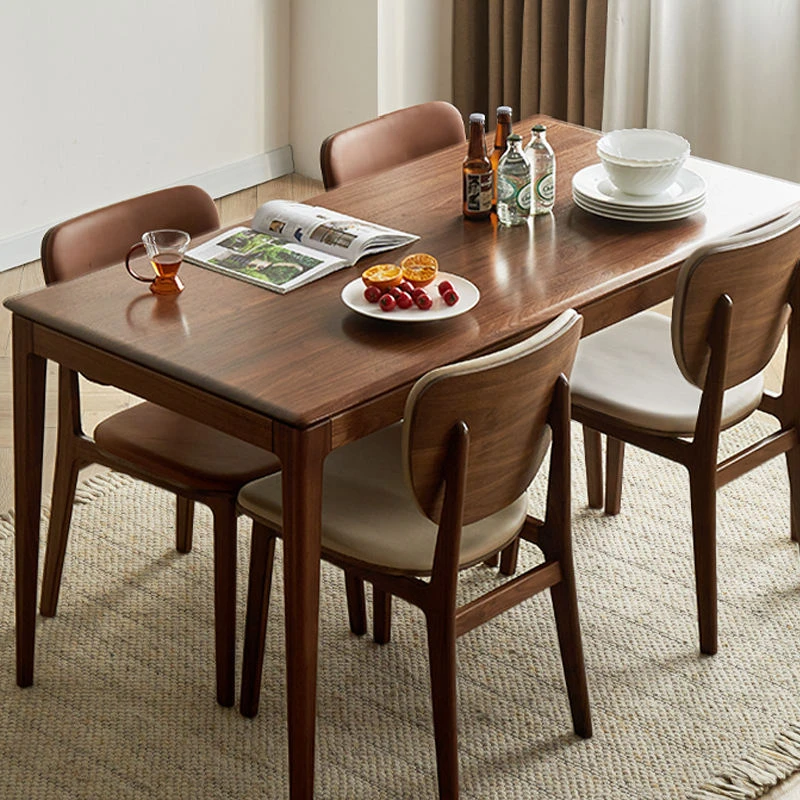
Dining tables and kitchen tables. The top sets the perception of the whole product. Solid wood tops in oak, walnut or ash justify a price premium and photograph well for online retail; veneered MDF tops on a solid frame hit a lower price point with a similar look. Legs and aprons should be solid wood for joint strength. Whatever the top, plan for seasonal movement across the width.
Dining chairs and benches. This is the most structurally demanding category you can import. Chairs take racking forces every time someone sits down. Insist on solid wood for legs, rails and the seat frame, and on properly glued and reinforced joints. A beautiful chair that loosens in the showroom destroys your returns rate.
Sideboards, buffets and cabinets. The practical answer for most programs is a plywood or MR board carcass with solid wood or veneered fronts for appearance and solid wood legs. This combines structural reliability with a finish customers will pay for.
Beds and bed frames. Load-bearing and highly stressed. Solid wood rails, slats and centre supports; avoid particleboard anywhere in the load path.
Bathroom vanities. The most hostile environment in the house. MR board or marine-grade plywood with fully sealed edges, plus a finish designed for humidity. Particleboard should be off the table here.
Storage, shelving and bookcases. Long unsupported spans in particleboard will sag. Either reduce span, increase thickness, or move to plywood or solid wood for the shelves.
Sofas and upholstered seating. The frame is invisible but determines whether the product survives three years or ten. Solid hardwood frames — kiln-dried, glued and screwed — are the difference between a repeat customer and a claim.
Mixed Construction Is Normal — Specify It Properly
Nearly all commercially successful furniture uses more than one material in the same piece: a solid oak top on a plywood carcass, an MDF painted door on a solid wood frame, a veneered MDF panel with solid wood edge banding. This is good engineering, not corner-cutting. The problem is not mixing materials; it is mixing them without specifying them.
Your purchase order should state, for every component: material type, species where applicable, board grade, thickness with tolerance, formaldehyde class, surface finish, edge treatment, and the moisture content range for solid wood. Add a requirement for the panel manufacturer or mill batch to stay consistent across the order so colour and gloss match between units. If your supplier cannot tell you the board grade of a component, you do not yet know what you are buying.
Manna Harmony Home builds both solid wood and panel furniture, and applies the same discipline to each: FAS-grade hardwood for solid wood lines, incoming inspection covering species, grade, thickness, moisture content and defects for lumber, and single-batch panels within an order to keep colour and gloss consistent across a shipment.
How to Verify What You Actually Received
Test the specification, not the marketing.
- Look at an exposed edge. Plywood shows alternating veneer layers; MDF shows a uniform, smooth, dense core; particleboard shows large chips and voids. An edge band hides the core, so ask for a cut sample or inspect a drawer bottom.
- Weigh a piece. MDF is significantly heavier than plywood of the same size. A suspiciously light “MDF” panel is usually particleboard.
- Check the screw test. Drive a screw into the edge of a scrap and try to pull it out. The difference between plywood and particleboard is unmistakable.
- Put a drop of water on a raw edge. Watch for a raised lip within 20 minutes — a clear sign of non-MR core.
- Measure thickness at several points. Undersized panels are a common cost-reduction trick.
- Read the labels. Reputable panel suppliers mark board grade, formaldehyde class and batch.
- Ask for the incoming inspection record. A factory that inspects material at goods-in can produce one.
Choosing With Your Eyes Open
There is no universally right material. A $180 retail sideboard and a $900 retail sideboard should not be built the same way, and pretending otherwise is how importers get caught between margin and returns.
Decide your price point and your market’s climate first, then let the material follow. Specify every component in writing. Verify with a physical sample before the bulk order, and keep the approved sample in your own office, not at the factory.
If you need a manufacturer who can run solid oak and walnut programs alongside panel-based lines and hold the specification consistent across repeat orders, send us your product brief or browse our wholesale furniture collections. Our solid wood manufacturer checklist covers the verification questions in more detail.
FAQ
Is solid wood always better than MDF?
No. Solid wood is stronger and more repairable, but it costs more, moves with humidity and cannot hold a high-gloss uniform paint finish the way MDF can. For painted, routed and moulded fronts, MDF is often the better engineering choice.
Is MDF or plywood stronger?
Plywood, for almost every structural purpose. Its cross-laminated construction resists warping and holds fasteners far better. MDF is denser and machines more cleanly, but has lower screw-holding strength and swells permanently if water reaches the core.
What is the difference between MDF and particleboard?
MDF is made from fine wood fibre and is denser, smoother and stronger. Particleboard is made from larger wood chips and is cheaper, lighter and weaker. A simple weight check usually tells them apart.
Is plywood suitable for bathroom furniture?
Only with moisture-resistant or exterior-grade adhesive and fully sealed edges, and even then it should be paired with a humidity-resistant finish. Standard plywood is not a bathroom solution.
How do I stop a solid wood dining table from cracking?
Specify the moisture content range for your destination market, allow the top to move by using proper fastening, avoid wide glue-ups of the wrong species, and control indoor humidity after delivery. Most solid wood cracking is a moisture specification issue, not a manufacturing defect.
Which material should I choose for the lowest landed cost?
Particleboard with veneered or paper-wrapped surfaces keeps material cost down, but it also raises damage rates in transit and returns in humid markets. Compare total cost of ownership, not just the FOB price.
