

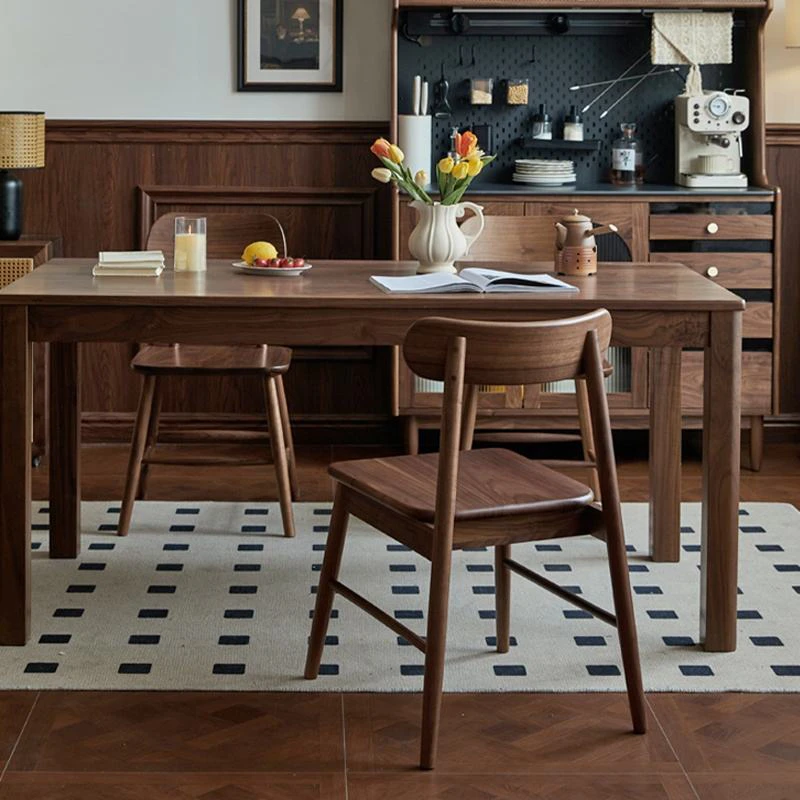
The Species Choice Sets Your Price Point Before You Set Your Price
Walk a furniture trade fair and the same four hardwoods appear again and again on the best real-wood stands: oak, black walnut, ash and cherry. They are not interchangeable. Each one carries a different hardness, a different grain language, a different colour trajectory and a different cost exposure — and those differences determine what your product can credibly be sold for.
Here is how the four compare in practice, what each one is genuinely good at, and how to specify species in an order so that the tenth container matches the first.
The Five Things That Actually Differ Between Hardwoods
Janka hardness measures the force required to embed a steel ball into the wood. It predicts how a surface resists dents from keys, chair legs dragging, and dropped objects. It is the single best predictor of how a tabletop will look after two years in a household with children.
Grain and figure determine the visual language. Closed, straight grain reads calm and modern. Open grain with prominent rays reads rustic and characterful. Cathedral grain reads warm and traditional.
Colour stability is the most under-considered factor. Some species shift dramatically with light and age; others hold their tone. If a customer buys a matching set over three years, the species that drifts will show it.
Dimensional stability governs how much the wood moves as humidity changes. Movement is normal in solid wood — it only becomes a complaint when the specification did not allow for it.
Supply and price risk is where species choice becomes a business decision rather than a design one. Sourcing a species whose supply chain is politically or climatically fragile transfers that risk to your margin.
The Four Hardwoods in Detail
White Oak — the workhorse of modern design
White oak sits in the sweet spot of hard, stable and beautiful. Its density and closed tyloses make it naturally more water-resistant than most hardwoods, which is why it has historically been the wood of boat decks and barrels. Visually it carries distinct medullary rays — the “tiger stripe” figure visible on quartersawn boards — and a pale, warm tone that takes stains evenly.
White oak has become the defining material of the “quiet luxury” and wabi-sabi direction in contemporary European and North American interiors. Designers now often leave natural knots and mineral streaks intact, treating them as evidence of a real material rather than a defect to be hidden. Wire-brushed and saw-marked finishes on white oak were near-ubiquitous in recent Milan collections.
Strengths: hard, dimensionally stable, moisture-tolerant, stains predictably, widely available, ages gracefully.
Weaknesses: open grain needs filling for a perfectly smooth finish; not a low-cost option; strong ray fleck can be rejected by buyers who want uniform grain.
Red Oak — the value alternative
Red oak is closely related and slightly softer, with a more open grain and a warmer, pinker tone. It takes stain well enough to be sold as almost anything, which is both its advantage and the source of its slightly dated reputation in premium markets. For mid-market programs it is an efficient choice; for a premium line it reads as a compromise next to white oak.
Strengths: good hardness per dollar, easy to machine and stain, abundant.
Weaknesses: large open pores need filler; pinkish undertone limits pale or cool finishes; perceived as less premium.
Black Walnut — the luxury staple
Black walnut is the wood that sells a premium line on sight. Rich chocolate-to-purple-brown heartwood, often with dramatic grain and sapwood contrast, it needs almost no stain to look expensive. Industry data suggests black walnut accounts for roughly a third of high-end solid wood furniture production, and it remains the default choice for luxury dining and bedroom ranges targeting North America.
The trade-off is hardness. Black walnut is meaningfully softer than oak, which means it dents more readily — a genuine consideration for dining tables in family homes. More than half of manufacturers now apply thermal smoking or micro-staining to move walnut toward a cooler, more contemporary palette, which also helps even out the natural colour variation between boards.
Strengths: unmatched visual warmth and luxury perception, excellent workability, stains and oils beautifully.
Weaknesses: softer surface, higher and more volatile cost, notable colour variation between boards requires careful selection.
Ash — the curve specialist
Ash is hard, tough and unusually good at steam bending, which makes it the material of choice for organic, curved and sculptural forms that would otherwise require complex joinery. Its pronounced cathedral grain gives it a lively, contemporary look. Pale, similar to oak in tone, it is frequently sold as a lighter, more affordable alternative — sometimes treated to mimic oak, and sometimes allowed to be its own thing. Ash is also under pressure in some markets due to pest-related trade restrictions, so confirm availability before specifying it for a long program.
Strengths: hard, excellent bending properties, dramatic grain, good value.
Weaknesses: very open grain, high colour variation, occasional supply restrictions in some regions.
Cherry — the wood that changes
Cherry is the softest of the four and the most distinctive in behaviour: its heartwood darkens substantially with exposure to light, moving from a pale pinkish tone toward a deep, warm reddish brown over months and years. Buyers either love this or are surprised by it, which means it needs to be communicated honestly. It machines and finishes beautifully and is a favourite for traditional and transitional ranges, and for pieces where a softening, aged character is the point.
Strengths: superb finishing, warm patina, excellent workability, softer grain than oak.
Weaknesses: softest surface of the four, colour change over time must be disclosed, colour variation between boards is significant.
Side-by-Side Comparison
| White Oak | Red Oak | Black Walnut | Ash | Cherry | |
|---|---|---|---|---|---|
| Janka hardness (lbf) | ~1360 | ~1290 | ~1010 | ~1320 | ~950 |
| Grain character | Rays, closed, calm | Open, coarse | Rich, dramatic, variable | Cathedral, bold | Fine, smooth |
| Colour | Pale warm | Warm pink | Dark chocolate | Pale cream | Pale, darkens with age |
| Colour stability | High | High | Moderate | High | Low — darkens notably |
| Dimensional stability | Excellent | Good | Good | Good | Very good |
| Moisture tolerance | High | Moderate | Moderate | Moderate | Moderate |
| Price band | Mid-high | Mid | High | Mid | Mid-high |
| Premium perception | High with good finish | Moderate | Highest | Rising | Traditional appeal |
| Best for | Dining, storage, vanities | Mid-market ranges | Luxury dining, bedroom | Curved seating, sculptural | Traditional ranges |
Janka values are typical published figures and vary by sample and moisture content.
Matching Species to Product
Dining tables. Oak and walnut dominate for good reason. White oak gives you hardness and a contemporary look; black walnut gives you instant premium signalling. If you sell walnut tables, specify that the surface will show wear more readily than oak and plan a matching aftercare story — see our guide to wood care and after-sales for how that affects returns rates.
Dining chairs and bar stools. Ash and oak. Both are hard and take the racking loads chairs see, and ash bends into the curved backs and scooped seats that sell. Walnut chairs are beautiful but their softer surface shows scuffs from chair-on-chair contact.
Sideboards and storage. A strong combination is a species-matched veneer face on a stable panel core with solid wood frames and legs. This keeps the appearance while controlling cost and movement on large flat surfaces.
Beds and bedroom ranges. Walnut and cherry both sell well here, because bedrooms reward warm, enveloping tones and the pieces are not subject to the same wear as a dining table.
Bathroom and kitchen furniture. White oak, for both hardness and natural moisture tolerance — followed by a finish built for humidity.
Outdoor-adjacent or humid climates. Lean on finish performance over species selection. A well-specified moisture-resistant system matters more than the wood underneath.
Colour, Finish and the 2027 Direction
Species choice does not end at the timber. How it is finished now changes the market a piece sells into.
Current direction across European and North American collections is toward ultra-matte, low-sheen water-based coatings in the 0°–5° range, which preserve a bare-wood tactile feel while eliminating the plastic look of traditional high-build lacquer. These coatings also help meet indoor air quality requirements.
Alongside this, bio-based oils and natural waxes — linseed, sunflower, beeswax — are being used to keep the wood’s open-pore structure and breathability. They are biodegradable, which supports a sustainability story, but they need more maintenance and are more vulnerable to water rings than a modern film finish. If you specify oil, specify the aftercare kit with it.
For walnut in particular, thermal smoking and micro-staining are now mainstream techniques for shifting the tone cooler and evening out board-to-board variation. Ask whether the finish is a stain over natural wood or a treated surface, because it affects both aftercare advice and repair options.
Cost and Supply Risk You Should Price In
Species decisions are supply-chain decisions. American hardwoods have seen real disruption: China’s 2025 restrictions on imports of US logs cut US market share in China significantly in a single year, and tariff and trade-policy shifts continue to push manufacturers toward diversified sourcing — Russian and European species, South American hardwoods, and in some cases domestic Chinese timber.
At the same time, the EU Deforestation Regulation is pushing certification and traceability requirements upstream, which raises the value of certified material and increases documentation costs on every container. Fast-growing and reclaimed timbers, plus FSC- and PEFC-certified species, are taking share in export programs that must prove origin.
Practical implications for your next program:
- Do not design a whole range around one volatile species without a qualified substitute.
- Ask for two approved species options per product, with a stated equivalence rule.
- Confirm the mill, origin and grade before committing to a long production schedule.
- Budget for certification and traceability paperwork, especially for EU-bound wood programs — see our EUDR guide for furniture importers.
How to Specify Species So the Tenth Container Matches the First
Vague species specification is where consistency dies. Put the following in writing for every order:
- Common and botanical name (for example, Quercus alba for white oak) — common names are used inconsistently across suppliers.
- Grade, such as FAS for visible faces, and which components may use a lower grade.
- Cut — plain sawn, quartersawn or rift sawn — because the cut determines the figure you get.
- Heartwood and sapwood rules, including acceptable sapwood percentage on visible faces.
- Colour matching criteria, with a physical approved sample that travels with the order.
- Moisture content range appropriate to your destination market’s average indoor humidity.
- Board width and length requirements for glue-ups, so a tabletop is not built from narrow offcuts.
- Species substitution policy, in writing, with your approval required before any substitute is used.
A manufacturer with real material control will inspect species, grade, thickness, moisture content and grain at goods-in, and will commit to sourcing all panels and boards for one order from a single production batch so colour and gloss stay consistent across the shipment. That is the operating standard you should be asking for.
Manna Harmony Home runs solid wood programs in oak, black walnut, ash and cherry alongside panel-based lines. If you want to see how a specific species behaves in a specific product, send us your specification and we will tell you honestly what it will and will not do in your market. Our wholesale furniture collections show current solid wood programs, and our OEM and ODM process guide explains how a species decision moves from brief to container.
FAQ
Is oak or walnut better for a dining table?
Oak is harder and more moisture-tolerant, so it stands up better to daily use and spills. Walnut is softer but reads as more luxurious and needs less finishing to look expensive. For family use, oak. For a premium look with more careful handling, walnut.
Is walnut harder than oak?
No. Black walnut is typical around 1010 on the Janka scale, while white oak is around 1360 — oak is roughly a third harder. Walnut’s advantage is appearance and workability, not surface durability.
Is ash a good substitute for oak?
Visually, yes — ash is pale and hard, with a bolder grain. It also bends far better, making it the better choice for curved forms. Confirm current availability and any regional trade restrictions before building a long-running program on it.
Does cherry wood get darker over time?
Yes, noticeably. Cherry heartwood deepens toward a warm reddish brown with light exposure, typically over the first months to a few years. This is normal and should be disclosed to end customers in your product copy.
What is the best hardwood for furniture overall?
There is no single best. White oak is the best all-rounder for balance of hardness, stability and price. Black walnut is best when appearance drives the purchase. Ash is best for curved and sculptural forms. Cherry is best for traditional aesthetics where patina is welcome.
How do I stop colour variation between boards in one order?
Specify heartwood/sapwood rules and an approved colour sample, require all material for the order to come from one production batch, and ask for a pre-production assembly photo of the visible faces before finishing.
