

Why Dining Tables Are the Hardest Furniture Category to Get Right
A dining table is the piece customers sit at, lean on, and judge you by. It is also the piece most likely to arrive damaged, the piece most sensitive to humidity change, and the piece where a small specification error becomes a visible, expensive complaint.
For a retailer, dining tables are worth the effort. They are high-ticket, they anchor a room set — chairs, benches, sideboards, lighting — and proven designs keep selling for years rather than seasons. But getting a dining table program right takes more specification discipline than almost any other category you will import.
This guide covers what to decide before you ask for a quotation, and the specification points that separate a program with 2% claims from one with 15%.
Start With the Retail Decision, Not the Product
Before dimensions and finishes, answer four commercial questions:
What channel is this for? A furniture showroom, a mid-market online retailer and a marketplace seller need different things. Showroom stock tolerates assembly labour; pure e-commerce lives or dies on packaging and self-assembly experience.
What is the entry price point? This decides material class more than anything else — solid hardwood, veneered panel, or a hybrid.
What seating count do you need to cover? Two-, four-, six- and eight-seater demand different footprints. Most successful programs launch with a hero size and a second size, not six.
Is the market urban and space-constrained? If so, extension and space-saving mechanisms are not optional extras — they are the reason the product sells.
The Dimensions That Decide Whether It Sells
Get these wrong and the table is unsellable regardless of how good the wood is.
Height. Around 75 cm (29.5 in) is the global standard for a dining table, matched to a 45 cm (17.5 in) seat height chair. Deviate only if your chairs deviate with it.
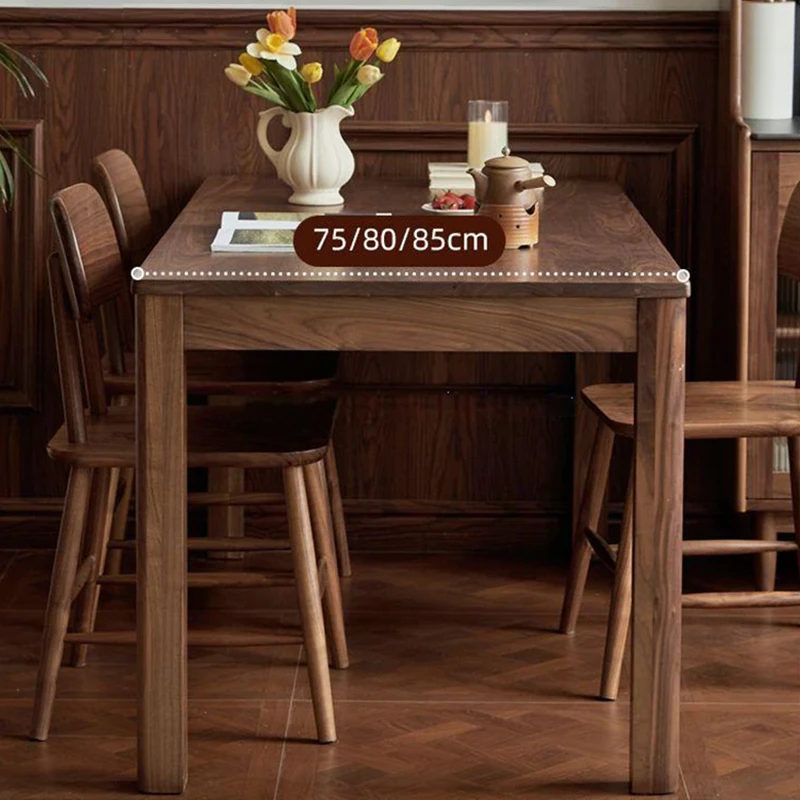
Width (depth). 90 cm (35 in) is comfortable for a full place setting with serving dishes in the middle. 75–80 cm works for compact urban apartments. Below 75 cm the table feels cramped for two-sided seating.
Length and seating count. Planning roughly 60 cm (23–24 in) of table edge per person is the practical rule:
| Seats | Rectangular length | Round / oval diameter |
|---|---|---|
| 2 | 70–80 cm | 70–80 cm |
| 4 | 120–140 cm | 100–110 cm |
| 6 | 160–180 cm | 120–130 cm |
| 8 | 200–240 cm | 140–150 cm |
| 10+ | 260 cm+ | 160 cm+ |
Leg room. The distance between legs, and between leg and table edge, determines whether people can actually sit down comfortably. A table with beautiful proportions but a leg planted where a knee should be will be returned.
Apron and leg positioning at the corners. Corner legs limit elbow room. If you want maximum seating for a given length, ask for pedestal, trestle, or offset-leg construction.
Top Thickness, Edges and Structural Honesty
Top thickness is where cost and perceived quality collide. Common specifications run 18 mm, 20 mm, 25 mm and 40 mm. A 25 mm solid top reads as a premium product; an 18 mm veneered panel with a thick edge band can look similar in a photograph and feel very different in person.
Whatever the thickness, ask these questions:
- Is the top solid, veneered, or a solid-wood-edged panel? The three look alike in renders and price very differently.
- How is the top constructed across its width? Wide glue-ups of narrow strips move more and can telegraph joint lines. Ask for board width and length minimums.
- What edge profile? Chamfer, square, bullnose, pill, waterfall — the profile also affects how the edge takes impact damage.
- How is the top fastened to the base? Solid wood tops must be able to expand and contract. Figure-eight fasteners, slotted brackets or z-clips are the right answer. Screws driven straight through a solid top will crack it when the seasons change.
- What is the moisture content of the timber at dispatch? This should be specified against your destination market’s typical indoor humidity, not against the factory’s local climate.
Extension and Space-Saving Mechanisms
For urban markets, an extendable table outsells a fixed one at the same price. Mechanisms to understand:
Butterfly / self-storing leaf. The leaf folds into the table body and lifts out when needed. Convenient and storage-free, but it consumes interior space and adds mechanism cost.
Drop leaf. Hinged side sections that fold down against the frame. Excellent for very small apartments, and typically the least expensive extension solution. The frame and hinge rating matter — specify the load capacity.
Separate leaf. The most robust and simplest mechanism; the leaf is stored elsewhere. Cheapest to manufacture and the most reliable long-term.
Gate-leg. Classic solution that swings legs out to support a dropped leaf. Great design value, more moving parts to inspect.
Telescoping / sliding rail. Common on premium extendables; the rail quality determines whether the table still opens smoothly in year five. Ask for the slide rating and the number of cycles tested.
For every mechanism, inspect: rail bearing quality, locking engagement, whether a single person can operate it, and how the extension leaf matches the main top for colour and grain. A leaf that is visibly darker than the top is a common and avoidable complaint.
Materials by Price Tier
Entry tier. Veneered panel tops with solid wood edge banding over a stable core — an effective way to deliver a convincing wood-look table at a competitive price. The critical specification is the core grade and edge treatment.
Mid tier. Solid wood tops in oak, ash or rubberwood on solid frames, or a hybrid of a solid top with a panel understructure. This is where most successful export programs sit.
Premium tier. FAS-grade solid white oak or black walnut, thick tops, quartersawn or rift-sawn faces, premium hardware, and a finish system built for the market. Merchandise these on material integrity, not just looks — see our hardwood species comparison for how oak, walnut, ash and cherry differ in hardness, colour stability and price risk.
A note on materials and regulation: wood content is increasingly subject to origin documentation. If you sell into the EU, read our EUDR compliance guide before you finalise the range, because the species and mill behind the table now matter commercially, not just aesthetically.
Finishes: What Is Actually Selling
Current demand leans toward ultra-matte, low-sheen surfaces in the 0°–5° range, usually water-based, which preserve the tactile feel of raw wood instead of the wet, plastic look of thick lacquer. They also help with indoor air quality requirements.
Alongside matte lacquer, natural oil and wax finishes are being specified for their openness and biodegradability, but they need a supplied aftercare kit and honest expectations — an oiled top marks more readily than a lacquered one and needs re-oiling.
On walnut, thermal smoking and light micro-staining are now standard techniques to shift the tone cooler and reduce board-to-board colour variation. White oak is frequently wire-brushed or given light saw-mark texture to emphasise a natural, tactile surface.
Two finish questions to settle in writing: what sheen level, and what is the recommended aftercare procedure. The second matters for your returns rate more than the first.
Flat-Pack or Assembled: The Decision That Moves Your Landed Cost
This choice drives freight, damage rate, labour, customer experience and returns simultaneously.
Fully assembled gives the best customer experience and the lowest customer-assembly complaint rate. It also costs the most freight — a dining table is mostly air and volume — and requires the most protective packaging.
Flat-pack / knocked-down dramatically improves container utilisation and lowers freight per unit. It shifts assembly to your customer or your warehouse, and it raises the risk of assembly damage, missing hardware and instruction-related returns.
Partial knock-down is usually the right answer for dining tables: legs and base detached, top shipped as a single piece, hardware packaged in a labelled blister with a printed instruction sheet and a spare fitting set. Get the assembly step count down and the experience stops generating complaints.
Agree on the target container fill in advance. A well-designed dining table program should be planned around a specific case configuration and pack quantity per pallet or per layer, not designed first and packed later.
Packaging: Where Dining Table Claims Come From
Dining tables are the highest-damage furniture category in ocean freight, almost entirely because of the top.
- Protect the top as a separate, rigid package. Corners are the first thing to fail — use moulded corner protectors, not foam wrap alone.
- Specify the corrugated grade and the drop-test standard. Ask what drop height the pack is designed for and what test was run.
- Isolate the surface. Any movement between the top and the case will burnish or scratch a matte finish. Use non-abrasive interleaving.
- Control humidity inside the case. Desiccant bags and, where relevant, a moisture barrier liner protect both wood and finish through temperature swings in transit.
- Load and restrain properly. Blocking and bracing, not just “tight packing”, prevents shifting. Our container loading checklist covers the twelve practical essentials.
- Label with handling orientation and a scan-ready barcode. Your warehouse will thank you and your damage rate will drop.
Ask for loading photographs of every shipment. It is a small request with a large effect on accountability.
Planning the Range and the MOQ
Most dining table programs fail by launching too many variants. A tighter range converts better and costs less to make.
A practical launch set:
- One hero rectangle in your primary species
- One round or oval for the smaller-space buyer
- One extension model for the urban apartment channel
- Two finish options per design at most
- Matching bench or chair within the same material family, to sell as a set
Keeping the whole range on one species, one finish system and one hardware family reduces per-SKU minimums significantly, because the factory’s material and setup costs are shared. If MOQ is your constraint, read our first order and MOQ guide for the levers that actually move it.
Landed Cost You Should Be Modelling
FOB price is roughly a third of the story. Model:
- FOB unit price
- Freight and insurance (heavily dependent on your pack design)
- Duty and any applicable trade measures by destination
- Port charges, customs brokerage, and inland transport
- Warehouse handling and any assembly labour
- Expected damage and claim allowance — this line is real, and pack design is the way to control it
- Marketing photography and sample costs, amortised across the run
A table with a slightly higher FOB and a genuinely better pack frequently lands cheaper than a cheaper table with a weak case.
Quality Checks Before the Container Leaves
Run these before you release the balance payment:
- Dimensional verification against the approved drawing, including leg room and height
- Top flatness checked across the diagonal, not just along one edge
- Mechanism cycle test on extendable models
- Finish comparison against the sealed golden sample, under the same light
- Moisture content reading on solid components
- Joint and fastener inspection, including glue squeeze-out and any hardware misalignment
- Pack inspection and a drop test on one or two cartons
- Loading photographs of the finished container
A factory that welcomes these checks is a factory that expects to pass them.
Building a Program, Not Just a Purchase
The dining table is the piece that carries the room, and the category that rewards discipline most. Specify dimensions against real seating maths. Match the material to the price point deliberately. Decide the flat-pack trade-off on purpose. Design the packaging with the same care as the product.
Manna Harmony Home manufactures solid wood and panel dining tables — including folding, extendable and fixed designs — in white oak, black walnut, ash and cherry, alongside matching benches, chairs and sideboards. To discuss a dining program, send us your specification and target price point, or browse our current dining room collections.
FAQ
What is the standard height of a dining table?
Around 75 cm (29.5 in), matched with chairs at roughly 45 cm (17.5 in) seat height. Consistency between the two matters more than the exact figure.
Is a solid wood dining table better than veneered MDF?
Solid wood is harder, repairable and carries a premium perception. Veneered MDF over a stable core gives a similar appearance at a lower cost and less seasonal movement. The right answer depends on your price point and how you merchandise the product.
How many people can sit at a 160 cm table?
Six comfortably, at roughly 60 cm of edge per person. Four if you want generous spacing for entertaining.
What thickness should a dining table top be?
25 mm reads as a solid, premium table. 18–20 mm is standard for veneered panel and mid-market products. 40 mm and above is a statement specification used on premium solid wood designs.
How do I reduce dining table damage in shipping?
Treat the top as a separate rigid package with moulded corner protection, control in-case humidity with desiccant, restrain the load with proper blocking, and require loading photographs. Damage is a packaging design problem, not bad luck.
What is a typical MOQ for dining tables?
Commonly 20–50 pieces per design and finish, though it varies with species, size and mechanism. Mixing designs into one full container usually allows lower per-SKU quantities.
